How to Quit Smoking
Smoking cigarettes gives the user a pleasant sensation; unfortunately, however, it leads to addiction—a state in which a person feels restlessness, anxiety, distress, or irritability without a cigarette. For individuals with a developed addiction, it is therefore difficult to quit smoking. Over the years, cigarettes become an integral part of a person’s life, and if someone wants to quit smoking, they often have to change their entire lifestyle.
The most important factor at the outset is motivation. While smoking, people naturally weigh its risks against its benefits. Information about the harmful effects of smoking is widely available, and smokers often accept these risks. Especially at a younger age, the risks may seem small and the complications associated with smoking negligible. As people age, the risks are often perceived more acutely, and at a certain point, the fear of smoking may outweigh the benefits to such an extent that the individual tries to quit. This happens especially if one of the complications of smoking has already manifested itself and quitting can clearly prolong the patient’s life. For example, if a smoker quits after suffering a myocardial infarction, they reduce their risk of death in the following years by half, which is a greater effect than can be achieved by taking most medications after a myocardial infarction. Simply cutting back on smoking can often help reduce the risk as well. This can be seen, for example, in the risk of developing lung cancer, although the effect is not as pronounced as when a smoker quits completely.
If a person decides to quit smoking and does so, they may be surprised by the discomfort they experience in the period following the cessation of smoking. Withdrawal symptoms, known as withdrawal syndrome, begin to develop. These symptoms may include irritability, restlessness, anxiety, or insomnia. The degree of nicotine dependence can be estimated based on how early in the morning a smoker must light a cigarette, how many cigarettes they smoke per day, whether they have trouble refraining from smoking in places where smoking is prohibited, or whether they smoke even when ill and spending most of the day in bed. To determine the degree of dependence, one of several questionnaires can be used— the Fagerström Test for Nicotine Dependence or the simpler Smoking Severity Index. In the early stages, support from loved ones and family is helpful. If an individual lives among other smokers, it can be helpful if they also begin to quit and support one another. It has been found that successful smoking cessation is more likely to be achieved through abrupt cessation rather than gradual reduction. In the case of a concurrent serious illness, hospitalization for that condition can also be utilized to overcome initial withdrawal symptoms.
Even after overcoming the initial phase, the urge to light a cigarette persists in various situations that were previously associated with smoking. It is helpful to identify these situations, avoid them if possible, or replace smoking with another activity when they arise. If smoking is replaced with eating, weight gain may occur. A more suitable substitute for smoking is another activity that does not significantly increase the body’s energy intake—ideally physical activity, drinking water, tea, and the like. If we change our lifestyle by eliminating activities we associate with cigarettes, we increase the likelihood of quitting smoking. A comprehensive lifestyle change is therefore very important. An approach where everything else remains the same and only smoking is eliminated may not always lead to the desired effect. It is therefore advisable to carefully consider your lifestyle and plan a comprehensive change.
You don’t have to quit smoking on your own. The healthcare system offers a range of resources to support individuals in quitting smoking. You can take advantage of these resources right from the start, or you can first try to quit on your own and turn to professionals only if you’re unsuccessful. Support involves a consultation with a psychologist or other trained professional who can help identify potential obstacles to quitting, assist with lifestyle changes, and advise on how to cope when the urge to smoke arises. This form of psychological support is known as cognitive-behavioral therapy. Another form of support for smoking cessation is pharmacotherapy, which helps alleviate withdrawal symptoms.
In general, professional help with smoking cessation is available at several locations. In inpatient facilities and clinics, you can find Centers for Tobacco Dependence. Professional counseling for smoking cessation is also available at selected pharmacies accredited by the Czech Chamber of Pharmacists. Help with quitting smoking can also be found at general practitioners or directly at addiction clinics, i.e., clinics specializing in addiction treatment. More detailed information and a search for individual clinics can be found on the website of Society for the Treatment of Tobacco Addiction. The National Quitline is also available at 800 350 000 on weekdays from 10 a.m. to 6 p.m., or you can contact the service via email at poradna@chciodvykat.cz
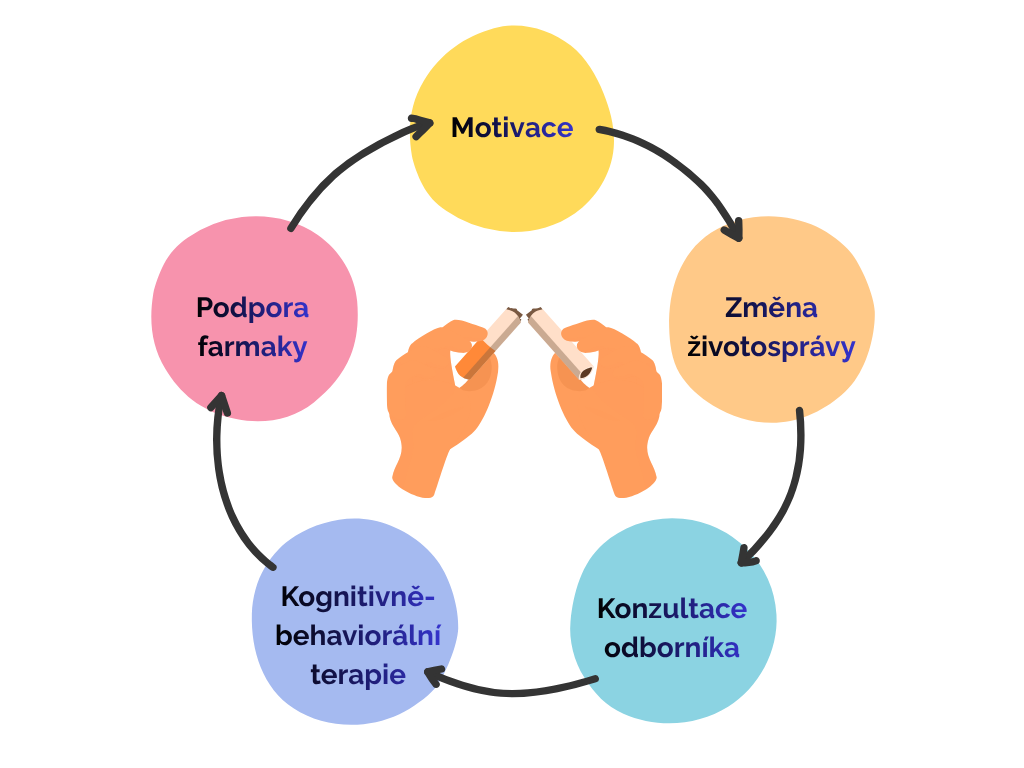
The main principles of smoking cessation: motivation, counseling, cognitive-behavioral therapy, lifestyle changes, and medication support.
Cognitive-behavioral therapy has been proven effective in smoking cessation. According to various data, it can increase the likelihood of successfully quitting smoking by 1.5 to 3 times, making it similarly effective to pharmacotherapy. Cognitive-behavioral therapy is provided by a psychologist. Both individual and group therapy are available. Currently, methods for smoking cessation using text messages or mobile apps are also being tested. The foundation of cognitive-behavioral therapy is a conversation with the smoker to determine how significant a role cigarettes play in their life. When the smoker experiences a craving, the therapist then teaches them how to cope with this situation. It is also important to address any distorted expectations the smoker may have, such as the belief that cigarettes reduce stress or help manage difficult life situations. One method of therapy involves setting a specific date to quit smoking and creating a plan for how to behave afterward, what to do when a craving arises, and how to avoid situations that trigger the urge to smoke. Cognitive-behavioral therapy also involves identifying and adopting alternative activities that help cope with cigarette cravings, such as exercise, sports, hobbies, walking the dog, meditation, deep breathing, drinking water, or chewing gum. The therapist helps the smoker distance themselves from negative thoughts associated with quitting smoking, thereby enabling the smoker to better reevaluate their current views and behaviors.
Over-the-counter medications can be used for pharmacotherapy; a pharmacist can assist with selecting them. These include, in particular, nicotine (Nicorette, NiQuitin) in the form of long-acting patches or fast-acting oral forms such as gum, lozenges, or oral spray. Nicotine can also be inhaled using a special inhaler or via a nicotine cartridge in an electronic cigarette. It is recommended to start with the patch; if unsuccessful, combine the patch with one of the oral forms or inhalation. E-cigarettes as such are generally not recommended by health authorities for smoking cessation, but data from clinical studies indicate that they are slightly more effective for quitting than other forms of nicotine replacement. However, the individual may not actually quit the addiction and may continue using nicotine-containing e-cigarettes, in which case adverse effects—such as those on the cardiovascular system—persist.
Another over-the-counter medication used to help people quit smoking is cytisine (Defumoxan, Heavis, formerly Tabex). Cytisine is a natural substance similar to nicotine, but it is less potent. Its effectiveness in smoking cessation is relatively high. Its advantage is its low price compared to other products.
Prescription medications can also be used in the treatment of addiction, such as varenicline (Champix, Varenicline Glenmark) or bupropion (Bupropion Neuraxpharm, Wellbutrin). If the above medications fail, the antidepressant nortriptyline (Nortrilen). Varenicline is currently the most effective medication for treating cigarette addiction and is slightly more effective than cytisine. Its use reduces withdrawal symptoms and simultaneously decreases the sense of reward from smoking cigarettes. Bupropion is an antidepressant that was initially used for other indications and was subsequently found to help patients stop smoking. Its effectiveness was then verified specifically in the treatment of nicotine addiction.
A pharmacist or a doctor at a specialized tobacco addiction treatment center can help you determine the appropriate dosage for smoking cessation treatment. Below are the recommended dosages for each medication, based on the most common guidelines. The dosage often varies depending on the level of nicotine dependence determined by one of the tests mentioned above.
Nicotine replacement therapy (NRT)
Nicotine patch – available in 5 mg, 10 mg, and 15 mg doses released over 16 hours, and in 7 mg, 14 mg, and 21 mg doses released over 24 hours. The 10 mg/16-hour and 14 mg/24-hour doses correspond approximately to one pack of cigarettes smoked per day.
Chewing gum – 2 mg for low to moderate dependence, 4 mg for high dependence
Sublingual tablets - 2 mg strength
Lozenges – strengths ranging from 1 mg to 4 mg
Inhaler - capsules containing 10 mg of nicotine
Cytisin
After starting treatment, smoking should be reduced; if the desired effect is not achieved, treatment should be suspended and repeated in 3 months; otherwise, continue with the dosage indicated below. Smoking should be stopped completely within 5 days of starting treatment to prevent symptoms of nicotine overdose.
Days 1–3: 1 tablet (1.5 mg) every 2 hours, up to 6 tablets per day
Days 4–12: 1 tablet (1.5 mg) every 2.5 hours, up to 5 tablets per day
Days 13–16: 1 tablet (1.5 mg) every 3 hours, max. 4 tablets per day
Days 17–20: 1 tablet (1.5 mg) every 5 hours, max. 3 tablets per day
Days 21–25: 1 tablet (1.5 mg) every 10 hours, max. 2 tablets per day
Varenicline
Initial phase (weeks 1–2) – tablets in blister packs divided as follows: days 1–3: 1 tablet of 0.5 mg once daily; days 4–7: 1 tablet of 0.5 mg twice daily; days 8–14: 1 tablet of 1 mg twice daily
Maintenance phase (weeks 3–12) – boxes of 28 tablets (1 mg); take 1 tablet (1 mg) twice daily.
Smoking should be stopped between the 8th and 14th day of use; if this is not successful, continue using the product and try again a few days later.
Bupropion
For the first three days of treatment, take 1 tablet (150 mg) in the morning
For the remainder of the treatment, take 1 tablet (150 mg) twice daily, with at least an 8-hour interval between doses. The duration of treatment is 7–12 weeks.
For long-term treatment, the extended-release formulation Bupropion SR 150 mg may be taken once daily.
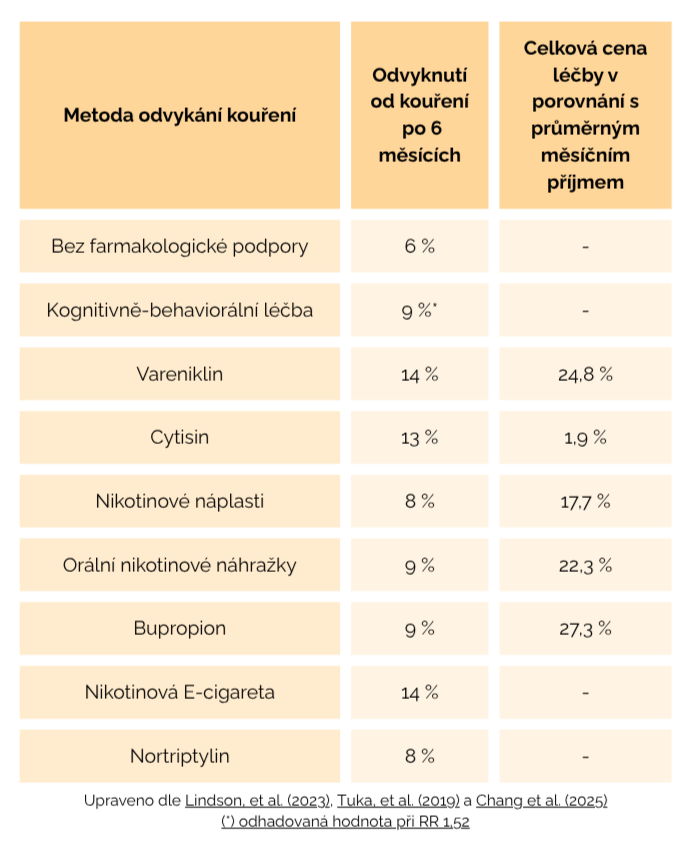
Probability of quitting smoking without assistance, using cognitive-behavioral therapy, and with various types of pharmacological support, including the total cost of the cessation program compared to average monthly income. Adapted from Adapted from Lindson, et al. (2023) and Tuka, et al. (2019) and Chang et al. (2025)
Smoking cessation products are not covered by public health insurance. However, most health insurance companies offer reimbursement up to a certain amount. Most commonly, health insurance companies contribute from 400 CZK once a year up to 2,500 CZK once every five years. The applicant must meet additional conditions, most often requiring a confirmation from one of the specialized centers for addiction treatment.
If attempts to quit smoking have failed, it is recommended to at least cut back on smoking. This can lead to a partial reduction in risk and, at the same time, help the person gradually gain the confidence needed to eventually quit completely.