How to Properly Monitor Your Blood Pressure at Home
The first mistake often occurs not during the measurement, but before it. After climbing the stairs, you sit down, quickly put on the cuff, and then take the result as an accurate reflection of your condition. But if you want to know how to monitor your blood pressure at home so that the readings are truly helpful to both you and your doctor, the details matter.
Home blood pressure monitoring is not a substitute for professional care. It is a practical way to track changes over time, distinguish between a random fluctuation and a recurring problem, and have data on hand that gives a cardiologist or primary care physician a much clearer picture than a single measurement taken in the office. For people with hypertension, fluctuating blood pressure, or heart conditions such as Coronary artery disease or heart failure, or when adjusting treatment, regular monitoring can be very useful.
Why It Makes Sense to Check Your Blood Pressure at Home
Blood pressure naturally fluctuates throughout the day. It is influenced by physical activity, stress, pain, fatigue, coffee, and sleep quality. That is precisely why a reading taken during a single clinic visit can be misleading. Some people experience the so-called white-coat effect—their blood pressure is higher at the clinic due to nervousness. In other cases, blood pressure is consistently higher at home but happens to be within the normal range at the doctor’s office.
Regular home blood pressure monitoring helps identify trends. This is more important for treatment decisions than a single reading. Your doctor isn’t just concerned with whether your blood pressure was 145/90 on one occasion, but whether similar readings recur, at what time of day they occur, and how they respond to medication or lifestyle changes.
How to monitor your blood pressure at home without skewing the results
The key is to use the right blood pressure monitor. For home use, an automatic upper-arm monitor is usually the most practical option. Wrist monitors may be convenient, but they tend to be more sensitive to the position of the hand and are less reliable for some patients. It is also important to use the correct cuff size. If the cuff is too small or too large, the results may be inaccurate.
Take at least five minutes to relax before taking your blood pressure. Do not measure your blood pressure immediately after physical exertion, after smoking a cigarette, after drinking coffee, or when you are very agitated. Sit with your back against the backrest, keep your feet flat on the floor, and do not cross your legs. The arm with the cuff should rest loosely at heart level.
Do not speak during the measurement. Even a short sentence can raise the reading. If you are measuring your blood pressure for the first time or after a long interval, it is advisable to measure it on both arms. If the difference is consistently significant, you should consult a doctor. For further monitoring, the arm that consistently yields higher readings is usually used.
It is good practice to take two measurements in succession, about a minute apart, and record either the average or both values. This is because a single reading may be affected by a momentary fluctuation.
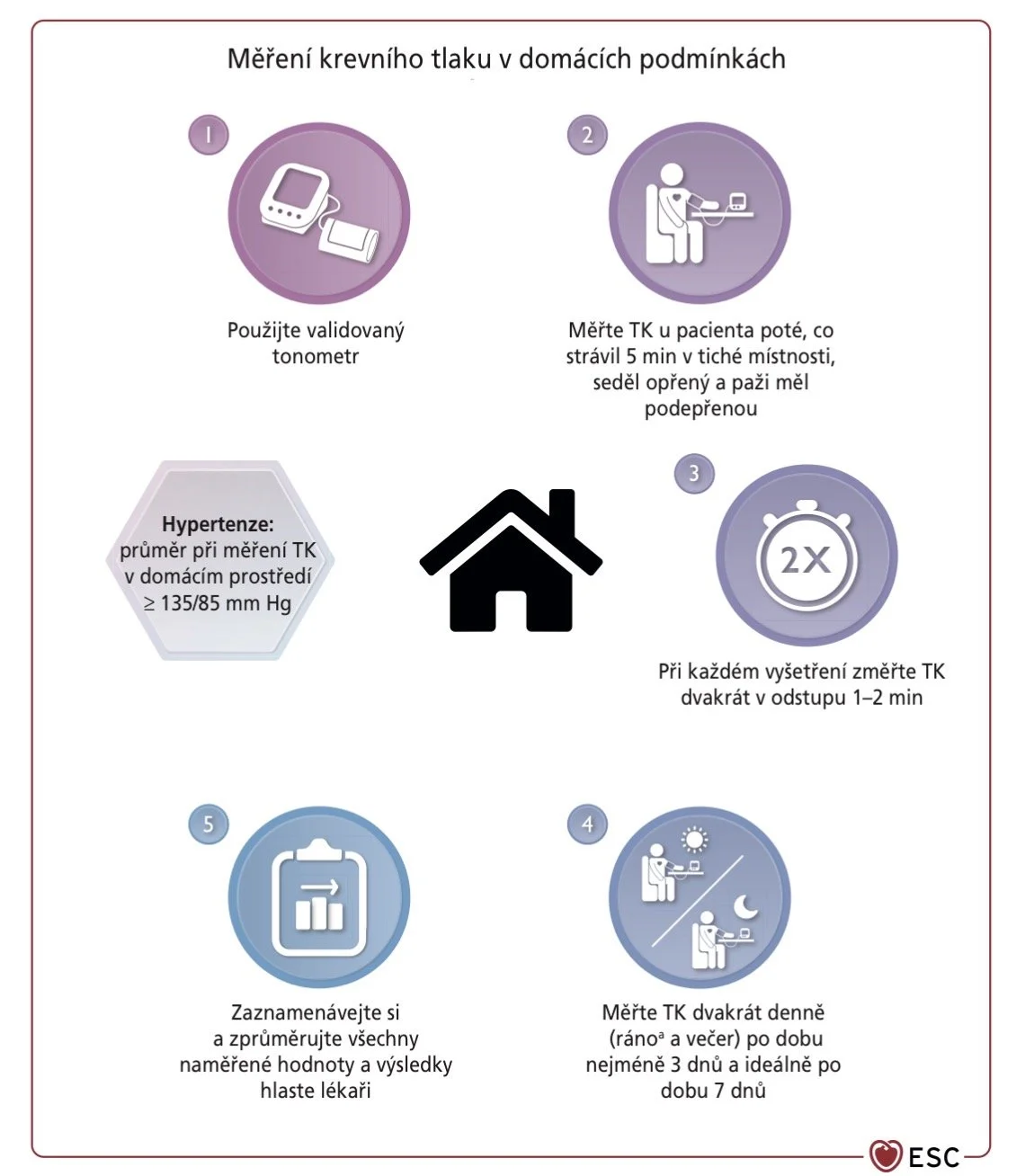
Home Blood Pressure Monitoring According to Current Guidelines from the European Society of Cardiology
When and how often to check your blood pressure
It depends on why you're monitoring your blood pressure. If you're just trying to determine whether you have a problem, or if your doctor has adjusted your treatment, it's usually best to measure your blood pressure in the morning before taking your medication and in the evening before bed. Doing this for several days in a row will give you a much more accurate picture than taking a random reading once a week.
If your blood pressure is already stable, you may not need to check it every day. For some patients, checking it a few days a month or as recommended by their doctor is sufficient. On the other hand, checking it too often can lead to anxiety and an unnecessary focus on individual fluctuations. The goal is not to check your blood pressure every hour, but to monitor it regularly.
It’s helpful to stick to a consistent routine. Take measurements at roughly the same time, under the same conditions, and using the same device. This is the only way to properly compare individual readings.
What metrics to track and what they mean
Blood pressure consists of two numbers. Systolic pressure is the top number and indicates the pressure in the blood vessels when the heart contracts. Diastolic pressure is the bottom number and corresponds to the phase between contractions. For home measurements, a value below 135/85 mmHg is generally considered acceptable, but this always depends on age, diagnosis, medications taken, and overall risk. Specific target blood pressure values based on age and risk factors can be calculated using a specialized calculator.
It’s important not to panic over a single high reading. If you were stressed, didn’t sleep well, or took the measurement without resting, the number may not mean anything. On the other hand, if your readings are consistently high, you shouldn’t put off seeing a doctor for too long.
Blood pressure that is too low—i.e., less than 100/50 mmHg—also warrants attention, especially if it is accompanied by weakness, dizziness, falls, or a worsening of symptoms after starting medication. For patients with heart disease, the goal is not simply to lower blood pressure, but to maintain it within a safe and well-tolerated range.
The most common mistakes in home testing
Poor technique is very common. Wearing the cuff over clothing, crossing your legs, talking during the measurement, or taking a reading immediately after coming home without allowing yourself enough time to settle down.
Another common mistake is evaluating data without context. An isolated value often doesn’t tell the whole story. You need to know when it was recorded, whether you were experiencing any difficulties, what your heart rate was, and whether it was a typical situation.
The third problem is that people don’t save their results anywhere. Memory isn’t enough. If you want your measurements to be truly useful, it’s a good idea to record the date, time, blood pressure reading, heart rate, and any notes. This is where the digital approach has a major advantage. A well-organized record makes it easier to identify patterns and changes over time.
How to Keep Records That Are Useful to Doctors
Your entries should be simple but consistent. A note like “blood pressure higher than usual” isn’t enough. Specific details are much more useful, such as “7:00 a.m. – 138/84, heart rate 72, before medication, no symptoms.” If you experience a headache, chest pressure, shortness of breath, heart palpitations, or dizziness, it’s a good idea to note it down.
For patients who track multiple metrics at once—such as blood pressure, heart rate, medication, and lab results—a paper-based system can become confusing. In such cases, having a single secure location where data can be stored long-term and shared during consultations is helpful. This is precisely one of the practical benefits of the mojesrdce.cz platform, which allows you to keep your cardiology data and communication with your specialist in one place. Modern blood pressure monitors automatically save data to your mobile phone, and this data can be automatically shared with the platform.
When Home Testing Is No Longer Enough
Home blood pressure monitoring is useful, but it has its limits. If you consistently get high readings, if your blood pressure fluctuates significantly, or if you experience new symptoms, it’s time to consult your doctor. This also applies if you’re unsure whether you’re taking your readings correctly or if the readings don’t make sense given your treatment.
Particular attention should be paid to chest pain accompanied by shortness of breath, slurred speech, weakness in the limbs, confusion, or a sudden severe headache. In such a situation, the priority is not to take further measurements, but to quickly assess the patient’s condition.
Sometimes a doctor will recommend a 24-hour ambulatory blood pressure monitoring test. This is usually recommended when home readings are unclear, when nocturnal hypertension is suspected, or when a more accurate assessment of the treatment’s effect throughout the day is needed.

24-hour ambulatory blood pressure monitoring
How to Turn Tracking into a Useful Habit
A simple routine that isn’t too burdensome works best. Keep your blood pressure monitor within easy reach, take your readings at the same time each day, and record the results immediately. Don’t try to track every fluctuation. Focus on consistency.
It also helps to know why you’re doing this. Not for the numbers themselves, but to gain better control over your treatment, detect changes early, and make decisions with greater peace of mind. Well-managed home monitoring can speed up treatment adjustments and help clarify issues that might otherwise remain unclear.
Blood pressure isn’t just a single reading from a monitor. It’s a signal that only makes sense when viewed in the right context. When you monitor it regularly, calmly, and with access to professional care, home blood pressure monitoring becomes a practical tool rather than a source of anxiety.